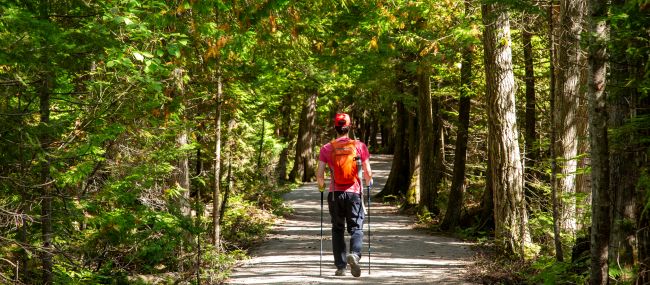
Enjoy quiet moments along the forest paths | Pete Heck
Blog home / Quiz: Fir, Spruce or Pine? A Christmas Tree Quiz You Can Take on the Trail
Ready to test your tree knowledge, one needle at a time? Canada is home to 369 million hectares (911.82 million acres) of forest and about 180 native tree species, so we've turned a few familiar favourites into a quick quiz that asks a simple question: how well do you know the trees you pass on the trail?
Put your instincts to the test, share your score and maybe even sharpen your tree identification skills in time for the upcoming season!
Fir, Spruce or Pine? A Christmas Tree Quiz You Can Take on the Trail is an interactive Great Canadian Trails quiz with 7 questions. ’Tis the season for evergreens! Put your trail-tested tree knowledge to the test. Question 1: While hiking the Bruce Trail, you find a needle that rolls easily between your fingers. What have you most likely found? Answer: Spruce needle. A fallen spruce needle is nature’s own trailside fidget companion. Most have four sides, making a square, so they turn smoothly between your thumb and finger. Question 2: Hiking in Gros Morne, you pass through wet boreal forest. Which tree dominates its forest while remaining a favourite Newfoundland Christmas tree? Answer: Balsam fir. In Gros Morne’s damp boreal forests, balsam fir leads the way. You can recognize it by its flat needles, which usually grow in two rows and show a glossy deep green above and a pale, whitish underside. Question 3: Now for a twist. Which is the official tree of Newfoundland and Labrador, home to the beautiful East Coast Trail? Answer: Black spruce. Balsam fir may be a holiday favourite, but black spruce has held the official title since November 1993. Also called bog spruce, this hardy evergreen has iconic dark bluish-green needles and is the most abundant tree in Labrador. It can also be observed on the left-hand side of the Labrador flag. Question 4: While hiking in Cape Breton Highlands, you spot a moose snacking on young trees. Which of these is it least likely to browse? Answer: Black spruce. Moose typically pass through black spruce areas to reach tastier browse, and the region’s white birch, balsam fir and American mountain ash are all on the menu! Black spruce’s small, stiff, waxy needles likely make it a less tasty snack. You can spot black spruce on the trail by looking out for short, four-sided needles that are a dark bluish-green. Question 5: Every year, Nova Scotia, home province of the Rum Runners Trail, sends a Christmas tree to which city? Answer: Boston. When the 1917 Halifax Explosion devastated the city, Boston rushed doctors, nurses and supplies north. As a thank-you, Halifax provided the city of Boston with a Christmas tree in 1918. This long-standing tradition was revived in 1971, and decades later, Nova Scotia still sends a tree each Christmas season to light up Boston Common, a symbol of friendship and Canadian kindness. Question 6: While cycling the Rideau Heritage Route, you stop for a water break and spot long, soft needles growing in bundles of five. Which tree has caught your eye? Answer: Eastern white pine. Eastern white pine has five soft needles per bundle, one for each letter in “white”. With feathery needles up to 15 centimetres long that hold up well after cutting, it is a popular option for Christmas garlands. Question 7: Hiking Quebec’s Traversée de Charlevoix, you notice a tree’s cones standing upright on its branches. Which tree is it? Answer: Fir. Fir cones sit upright like candles, often near the top of the tree, while spruce and pine cones generally hang downward. Young fir cones can be green, purple or bluish, turning brown as they mature. Final scores lead to one of 3 results: Seedling Spotter! (0 to 2 correct answers), Evergreen Explorer! (3 to 5 correct answers), Forest Legend! (6 to 7 correct answers).
A single needle or cone can tell you a lot about where you are and what's growing around you. Across Canada's eight forest regions, each tree adds to the character of the landscape, from sturdy black spruce to soft, feathery white pine. Try your new tree identification skills on your own Christmas tree this December, then take them on the trail next summer.
Whether it's a cool patch of shade, the fresh scent of fir or a cone you've never noticed before, Canada's forests have a way of turning a simple water break into the highlight of the day. From Gros Morne to the Rideau Heritage Trail, your next adventure awaits! Explore our self-guided and guided hiking and cycling trips and hit the trail with Great Canadian Trails!