Climate Action: Carbon Label
How Great Canadian Trails Measure, Reduce, and Take Action
We’re excited to launch our Climate Action Plan: our commitment to genuine climate action.
Human-powered travel, whether walking, trekking, or cycling, has a much lower carbon footprint than many other forms of tourism. By choosing to travel under your own power, you are helping reduce reliance on high-emission transport and showing that adventure can be sustainable. But while our style of travel is comparatively low-carbon, we know we must go further because we want to be part of the solution to climate change.
Each year, we commit to measuring our carbon footprint and using the results to identify and implement new strategies to cut emissions. Our goal is to contribute meaningfully to the global ambition of achieving Net Zero emissions by 2050.
Alongside this, Great Canadian Trails will offset the unavoidable carbon emissions from your land travel by supporting both Gold Standard-certified projects and local reforestation efforts in Canada. These initiatives help reduce or remove emissions while restoring natural landscapes and contributing to community and biodiversity benefits.
In addition, our Regenerative 2030 program supports projects aligned with climate action and promotes regeneration that goes beyond simply minimising impact.
What does this mean for you? It means carbon labels on trips so you can clearly see your estimated footprint.
Why carbon label our trips?
Carbon labelling our trips makes the invisible visible, showing you the estimated CO₂ emissions of your trip—just like a nutrition label on food. It’s a clear, honest way to understand your environmental impact, and it holds us accountable for reducing emissions.
As adventurers who thrive in wild, pristine places, we know protecting them starts with accountability. This plan is just the beginning, and we’re excited to have you along for the journey.
What do the numbers actually mean?
To help make sense of the carbon footprint shown on each trip, it’s useful to compare it to an average day at home. Here’s the estimated daily carbon footprint per person, based on national averages:
- Canada: 40.8 kg CO₂e
- Australia: 38.9 kg CO₂e
- USA: 37.8 kg CO₂e
- New Zealand: 19.8 kg CO₂e
- UK: 12.1 kg CO₂e
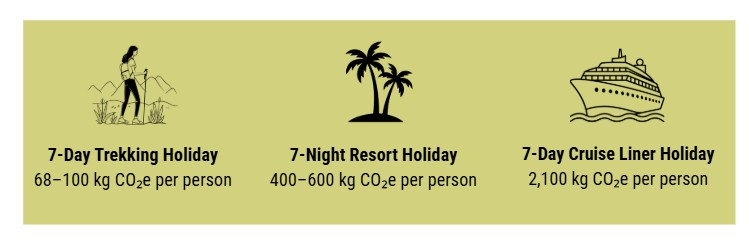
These figures are based on each country’s annual per-person emissions divided across 365 days. It provides a baseline to see how your travel footprint compares.
Putting travel footprints into perspective… It shows how your travel choices truly make a difference—and that active, nature-based adventures can be some of the most rewarding and responsible ways to experience the world.
What have we measured?
The carbon footprint calculations cover everything included in the cost of your trip: meals, accommodation, transport, activities, and your guide. For self-guided tours, this only includes the elements we directly facilitate, not your personal travel, meals, or additional activities.
Each trip also includes a pro rata share of emissions from our wider operations, including offices, staff travel, and website management. We have not included flights to and from your destination.
What about your flights?
For example, the carbon footprint for a return flight from Sydney to Kathmandu in economy class ranges between 1.6 and 2.2 tonnes CO₂e, depending on aircraft type, stopovers, and other factors.
There are ways to reduce the carbon footprint of your flights:
- Choose direct flights where possible.
- Opt for newer, more fuel-efficient aircraft.
- Fly economy to lower your emissions share.
- Travel less often but stay longer.
- Replace flights with rail where possible.
Google Flights and Skyscanner use Travalyst emissions data to help you choose lower-emission options.
Behind the numbers
The work to measure our carbon footprint and identify areas for reduction was carried out by carbon consultancy ecollective.
Take a look at the methodology they used.